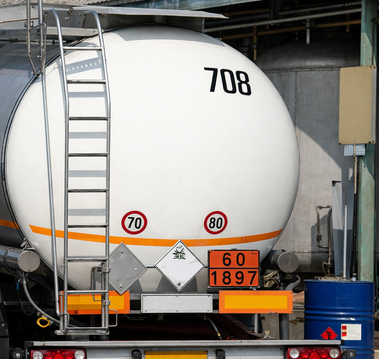
In processes that handle flammable liquids or combustible dusts, every transfer generates electrostatic charges. If the container is not earthed, these charges build up until they discharge as a spark, which is often enough to ignite an explosive atmosphere.
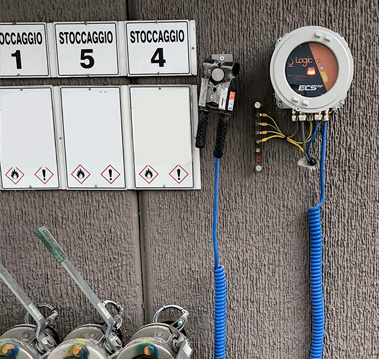
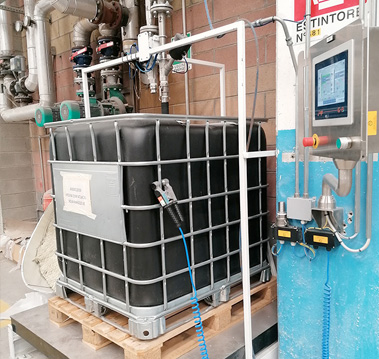
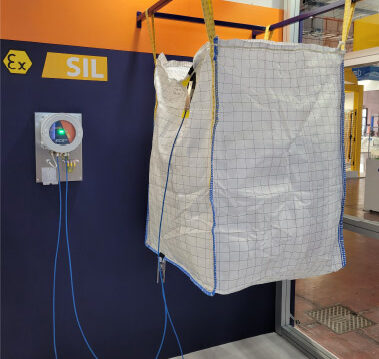
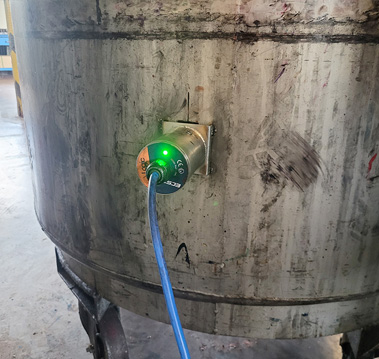
Logic ATEX earthing clamps and static earthing (grounding) systems connect road tankers, drums, IBCs, Type C FIBC big bags and mobile tanks to earth, continuously verifying that the connection is effective: if the resistance to earth exceeds the safety threshold, the system alerts the operator and can stop the process.
The systems are designed and manufactured in Italy by Logic in accordance with ATEX Directive 2014/34/EU, in versions that can be installed in Zone 1/21 or Zone 2/22, or with the electronics in a safe area.
Electrostatic charges are generated in three ways:
Friction: liquid flowing through a pipe, or powder sliding through a hopper or into a big bag, separates electrical charges.
Electrostatic induction: a charged object induces a charge on a nearby conductive object, even without touching it.
Conduction: contact between two conductive objects, one of which is charged, transfers the charge from one to the other.
In a production area these phenomena occur continuously: when loading or unloading a road tanker, filling a drum, emptying a big bag or mixing in a tank. The risk increases with low-conductivity liquids (such as many solvents and hydrocarbons), high flow rates and fine powders.
Why earthing must be monitored
A clamp attached to an earthing cable makes the connection, but cannot verify that it is actually working. Paint, rust, dirt, vibration or a clamp attached in the wrong place can break the contact without any warning. The operator thinks they are protected, but they are not.
A monitored earthing system solves the problem:
it measures the resistance to earth and confirms that it is below the safety threshold (10 Ω for metal containers, a specific resistance window for Type C big bags)
it shows the connection status to the operator, with LEDs on the clamp or on the station
it checks the connection throughout the operation, not just when the clamp is attached
it acts in the event of a fault, with a SIL2-rated interlock contact that can stop pumps and valves
With monitoring, earthing no longer depends on the operator’s attention: it becomes a condition verified by the system.
Which system for which application
Application
Typical risk
Logic solution
Road tankers at loading / unloading bays
Tank insulated from earth by its tyres, large volumes transferred
Directive 2014/34/EU (ATEX equipment): requirements for equipment intended for use in potentially explosive atmospheres. Logic systems are designed in compliance with this Directive.
Directive 1999/92/EC (ATEX workplace), transposed into national law in every EU Member State (in Italy by Legislative Decree 81/08, Title XI): requires employers to assess the risk of explosion and to eliminate sources of ignition, including electrostatic discharges.
IEC TS 60079-32-1: technical guidance on electrostatic hazards, the reference for resistance-to-earth values.
IEC 61508: functional safety, the reference for Safety Integrity Level SIL2
Why choose Logic
For over 40 years Logic has designed automation systems for areas at risk of fire and explosion, and built turnkey process plants for the chemical, pharmaceutical and cosmetics industries. That is why our earthing systems are shaped by real use in the field:
LEDs on the clamp, where the operator is looking while attaching it
Dedicated solutions for each type of container, not one clamp for every application
A patented clamp that prevents the connection from being bypassed
Support with risk analysis and SIL assessment, through Logic’s engineering services
Frequently asked questions (FAQ)
When is earthing mandatory in an ATEX zone? Directive 1999/92/EC, transposed into national law in every EU Member State, requires employers to eliminate potential sources of ignition in areas with explosive atmospheres. Electrostatic discharges are one of the main sources of ignition. Specific measures, including the earthing of containers, follow from the plant’s fire and explosion risk assessment.
What is the difference between a passive earthing clamp and a monitored earthing system? A passive clamp makes the connection but does not verify that it is effective. A monitored system measures the resistance to earth, shows the status to the operator and acts if the connection is broken during the operation.
What is the correct resistance-to-earth value? For metal containers such as road tankers, drums and tanks, the reference value according to IEC TS 60079-32-1 is a resistance below 10 Ω. For Type C FIBC big bags a higher range of values is used, suited to the bag’s conductive mesh: Logic systems operate between 3 kΩ and 10 MΩ.
Can the same clamp be used for all containers? No. Each container has different requirements: a painted drum needs teeth that pierce the paint, a big bag needs a connection to its conductive tabs, and a mobile tank needs a connection that stays secure under vibration. That is why Logic offers a dedicated clamp for each application.
Can the monitoring system be installed in an ATEX zone? Yes. Logic monitoring units are available in versions for ATEX Zone 1/21 and ATEX Zone 2/22, and for DIN-rail mounting in an electrical panel in a safe area.