

Introduction
The European Union’s ATEX legislation consists of two fundamental directives, each with different purposes, scopes of application and target audiences:
- Directive 2014/34/EU – also known as ATEX ‘products’
- Directive 1999/92/EC – also known as ATEX ‘places’
Understanding the differences is essential to ensure the correct application of preventive measures and the compliance of equipment intended for use in potentially explosive atmospheres.
1. Purpose and scope
- Directive 2014/34/EU: regulates the marketing of the following products: equipment and systems intended for use in potentially explosive atmospheres, components intended to be part of such systems, and equipment and protective systems intended for use outside potentially explosive atmospheres but necessary or useful for the safe functioning of equipment and systems with regard to the risks of explosion. (Article 1)
- Directive 1999/92/EC: lays down minimum requirements for the safety and health protection of workers potentially at risk from explosive atmospheres (Article 1).
2. Recipients
- Directive 2014/34/EU: manufacturers, importers, distributors, notified bodies for the products referred to in paragraph 1.
- Directive 1999/92/EC: employers, safety managers, designers of installations where explosive atmospheres may occur.
3. Obligations
Directive 2014/34/EU requires:
- Product conformity assessment
- Preparation of technical documentation
- EU Declaration of Conformity (affixing of the CE mark)
- Explosion protection marking (hexagon Ex)
Directive 1999/92/EC requires:
- Classification of hazardous areas (Ex triangle)
- Preparation of the explosion risk assessment
- Drafting of the explosion protection document (DPE)
- Vocational training for workers
4. Technical compliance and markings
In order to comply with Directive 2014/34/EU, equipment intended for use in explosive atmospheres must meet the essential safety requirements through the application of harmonised technical standards of the EN/IEC 60079 series, such as: Ex d, Ex e, Ex i, Ex t (articles dedicated to individual protection methods will follow).
The logo identifying products that comply with Directive 2014/34/EU is as follows:

In order to comply with Directive 1999/92/EC, ATEX zone classification must be carried out in accordance with standards EN/IEC 60079-10-1 (gas) and 60079-10-2 (dust).
The logo identifying a classified area is as follows:
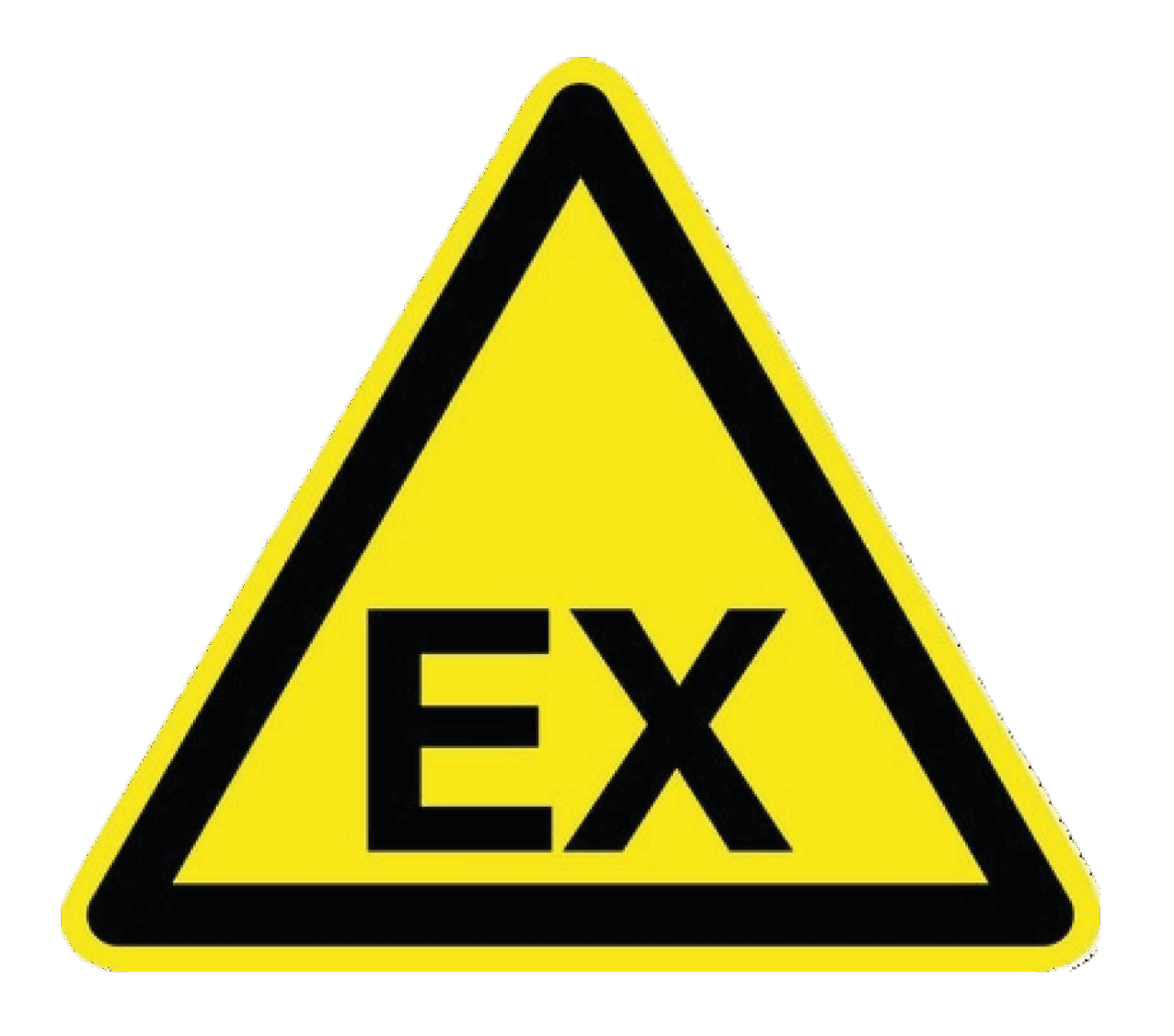
In accordance with general signage rules, the triangular shape indicates a hazard, which in this case is represented by the presence of a potentially explosive area.
|
Directive |
2014/34/UE |
1999/92/CE |
|
Purpose |
Product safety |
Workplace safety |
|
Intended recipients |
Manufacturers and distributors |
Employers and plant designers |
|
Main obligations |
Certification, marking, compliance |
Zone classification, EPC, worker training |
|
Technical standards |
EN 60079 series |
Mainly EN 60079-10-1 and 60079-10-2 |
10. Conclusions
Directives 1999/92/EC and 2014/34/EU should be seen as complementary: the former ensures that workplaces are designed, organised and maintained in a safe manner, while the latter guarantees that products are safe for use in the areas identified by the former. Only the combined application of the two directives allows for the effective protection of workers, facilities and industrial environments.
As Logic Srl, we are ATEX-certified manufacturers (of earthing systems and ATEX Panel PC) and are certified according to EN ISO/IEC 80079-34 in order to guarantee not only the technical compliance of ATEX products, but also the consistent quality of production processes, in line with the requirements of Directive 2014/34/EU.