

Explosive atmosphere
Definition of explosive atmosphere [Directive 2014/34/EU, Art. 2(4)]: a mixture containing air, under atmospheric conditions, flammable substances in the state of gas, vapour, mist or dust in which, after ignition, combustion spreads to the entire unburned mixture.
Definition of Potentially Explosive Atmosphere [Directive 2014/34/EU, Art. 2(5)]: an atmosphere which may become explosive due to local and operational conditions.
The standard atmospheric conditions considered are: temperature between -20°C and +60°C, pressure between 0.8 and 1.1 bar and oxygen concentration of 21% v/v.
Explosion Triangle (gases, vapours and mists)
The following conditions must occur simultaneously for an explosion to occur:
- Presence of fuel: in the form of gases, vapours and mists;
- Presence of the oxidiser in the atmosphere (typically oxygen);
- Presence of the ignition source: spark, hot surfaces, electrostatic discharge.
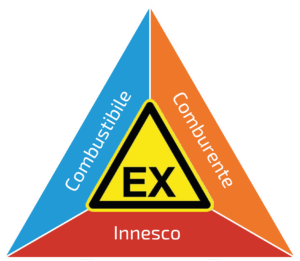
Elimination of one of these elements prevents ignition of the explosive atmosphere.
One aspect to be taken into account is the concentration in air for the atmosphere to become potentially explosive, hence the terms LEL (Lower Explosive Limit) and UEL (Upper Explosive Limit) expressed in volume percentage terms. The atmosphere will therefore be hazardous if the percentage of the hazardous substance dispersed in air is contained between the LEL and UEL; hence, the wider the range between LEL and UEL, the more hazardous the substance.
Classification of hazardous gases
Gases are classified into groups (IIA, IIB, IIC) according to their hazardousness using different parameters, the main ones being Minimum Ignition Energy (MIE) and Maximum Experimental Safe Gap (MESG), as shown in the table below:
Group | Typical examples | MESG (mm) | MIE (mJ) |
IIA | Propane and ammonia | > 0.9 | > 0.2 |
IIB | Ethylene and cyclopropane | 0.5 – 0.9 | 0.06 – 0.2 |
IIC | Hydrogen and acetylene | < 0.5 | < 0.06 |
Another aspect characterising the dangerousness of a gas is its ignition temperature, i.e. the lowest temperature at which the mixture ignites spontaneously.
The following is an example table of ignition temperatures:
Substance | Ignition temperature (°C) |
Diesel fuel | 220 |
Hexane | 225 |
Petrol | 250 |
Ethanol | 363 |
Butane | 372 |
Acetone | 465 |
Hydrogen | 500 |
The ignition temperature is important when choosing the device to use, because the temperature class parameter must be respected.
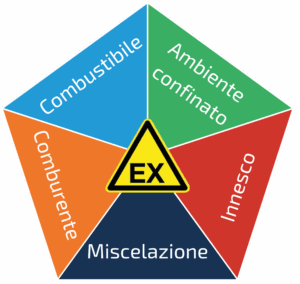
Explosion pentagon (powders)
For an explosion to occur, the following conditions must be met:
- Presence of combustible dust;
- Presence of the oxidiser in the atmosphere (typically oxygen);
- Presence of an ignition source: spark, hot surfaces, electrostatic discharges;
- Confined environment;
- Mixing of reagents.
Classification of hazardous dusts
Dusts are classified into groups (IIIA, IIIB, IIIC) based on the size of the solid dust particles and how conductive they are, as shown in the table below:
Group | Typical examples | Dimension (µm) | Type of powder |
IIA | Flour, sugar and cereals
| > 500 | Fuel |
IIIB | Plastic powders with additives and some synthetic fibres | ≤ 500 | Non-conductive (resistivity > 103 Ω*m) |
IIIC | Aluminium, magnesium and metal powders | ≤ 500 | Conductive (resistivity ≤ 103 Ω*m) |
Unlike gases (which have a uniquely defined ignition temperature), when talking about dust, two different scenarios must be distinguished in the calculation of the ignition temperature, with tests carried out in accordance with EN ISO/IEC 80079-20-2:
- In the case of a dust cloud: the ignition temperature of the cloud Tcl (cloud temperature) is defined.
- In the case of dust accumulation: the ignition temperature of a 5 mm layer is defined T5mm
These two ignition temperatures, Tcl e T5mm vwill then be taken into account when selecting the instrumentation to be used, because the maximum surface temperature parameter must be respected.