

Introduction
The classification of areas where explosive atmospheres may form is a fundamental step for workplace safety. This classification is mandatory for employers under Directive 1999/92/EC (contained in the DPE – Explosion Protection Document), allowing them to take appropriate preventive measures and choose suitable equipment that complies with Directive 2014/34/EU.
What is an ATEX zone?
An ATEX zone is an area where there is a risk of an explosive atmosphere forming in the presence of gases, vapours, mists or dusts. Classification depends on the frequency and duration with which this atmosphere may be present.
In general, the classification of areas is based on several factors, including:
- Nature of the hazardous substance (gases, vapours, dusts)
- Amounts released and frequency
- Duration of the explosive atmosphere
- Ventilation efficiency
- Probability of failures and losses
The main distinction in terms of regulations occurs when the ATEX zone is required due to the presence of gases, vapours or mists, or due to the presence of dust. The two types are listed below with their respective reference regulations.
Classification of zones – GAS, VAPOURS and CLOUDS
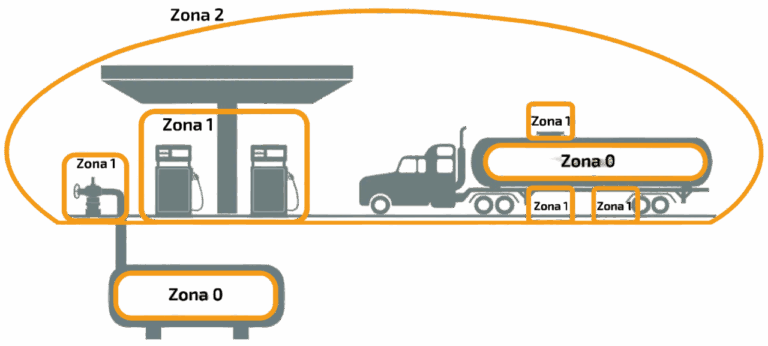
In this case, the relevant technical standard is EN IEC 60079-10-1:2021, and the following three zones are distinguished in ascending order of danger:
- Zone 2: explosive atmosphere present only occasionally or for a short period (less than 10 hours/year)
- Zone 1: explosive atmosphere present occasionally during normal operation (10-1,000 hours/year)
- Zone 0: explosive atmosphere present continuously or for long periods (more than 1,000 hours/year)
Below is an illustrative image for example purposes:
Classification of areas – DUST
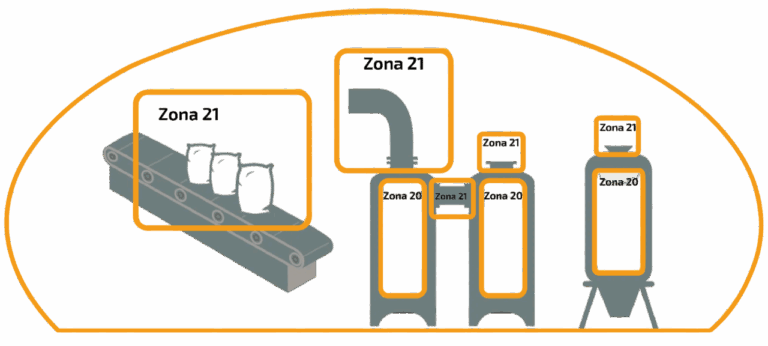
In this case, the reference technical standard is EN/IEC 60079-10-2:2015, and the following three zones are distinguished in ascending order of danger:
- Zone 22: rare and brief presence of combustible dust clouds (less than 10 hours/year).
- Zone 21: occasional presence of combustible dust clouds (10–1000 hours/year).
- Zone 20: continuous or frequent presence of combustible dust clouds (over 1000 hours/year).
Below is an illustrative image for example purposes:
The importance of correctly classifying areas
Each zone imposes minimum requirements for the category of equipment to be used. The next article will discuss the categorisation of devices and the EPL protection rating. As a general consideration, it is important to bear in mind that incorrect classification of zones can lead to two main problems:
- Inadequate classification (too imprudent) can lead to the selection of unsuitable equipment that could potentially generate ignition sources.
- Inadequate classification (too cautious) can lead to the selection of equipment that is more expensive than what is actually required by the process.
Summary table of zones and categories
ATEX zone | Frequency of explosive atmosphere | Time (hours) | Reference standard |
2 | Rare and short-lived | < 10 | 60079-10-1 |
1 | Occasionally | < 1.000 and > 10 | 60079-10-1 |
0 | Continuously or for long periods | > 1.000 | 60079-10-1 |
22 | Rare and short-lived | < 10 | 60079-10-2 |
21 | Occasionally | < 1.000 and > 10 | 60079-10-2 |
20 | Continuously or for long periods | > 1.000 | 60079-10-2 |